

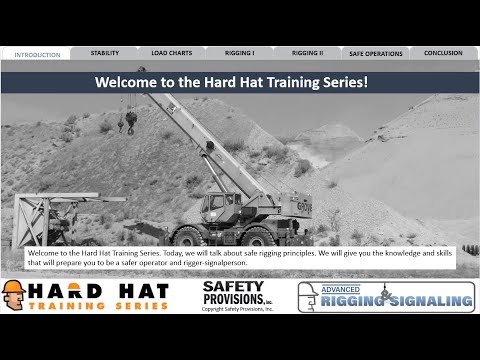
Course Overview
Our Rigger and Signalman training course is OSHA compliant, and our online version fulfills OSHA’s classroom training requirement.
This presentation includes intermittent practice quiz questions to prepare for the final written exam included with the course. In addition to the written exam, this course also includes a checklist for employers to use when administering a practical exam as required by OSHA.
- Introduction
- Stability
- Load Charts
- Sling Types
- Synthetic Slings
- Inspecting Slings
- Wire Rope Slings
- Chain Slings
- Hardware
- Shackles
- Inspecting Shackles
- Eye Bolts
- Lifting Devices
- Weight
- Angles and Stresses
- Sling Hitches
- Vertical Hitches
- Bridle Hitches
- Choker Hitches
- Basket Hitches
- Crane Operations
- Center of Gravity
- Critical Lifts
- Lifting Personnel
- Crane Safety
- PPE
- Know Your Worksite
- Communication
- General Hand Signals
- Crawler Crane Signals
- Overhead & Tower Crane
Signals
- Conclusion
Course Goals:
- Understand the importance of properly securing loads and avoiding common causes of rigging accidents.
- Recognize the different types of rigging equipment including slings, shackles, eye bolts, hooks and commonly used lifting devices.
- Learn the strengths and weaknesses of this equipment and how to inspect it.
- You will learn how to determine the weight of the load and calculate the angles and stresses of a pick. You will also learn the different ways to secure a load with sling hitches.
- Learn the fundamentals of crane operations including how to rig the load based on its center of gravity. You will also learn the requirements for critical lifts, tandem lifts, and lifting personnel.
- Understand safe crane operating principles including pre-lift planning and inspections. In addition, we cover the limitations of some equipment and safety features.
- Understand the changing conditions of your worksite.
- Use voice and hand signals to communicate with the crane operator when moving a load.
Estimated Training Length: Because everyone learns and progresses at different speeds, the amount of time you spend taking this training will vary. However, the estimated time for this training is 5.5-6 hours.
Intended Audience:
- Employees
- Supervisors
- Managers
- Employers
CEUs:
- This course counts as .6 CEUs.
- In order to earn CEUs, this course must be completed, and the final exam passed with a score of no less than 80%.
Compliance:
Though you will still need to familiarize yourself with all other applicable federal, state, and local standards, this training encompasses the following laws and regulations:
- 29 CFR 1926.180 – Crawler Locomotive and Truck Cranes
- 29 CFR 1926.1400 – Cranes and Derricks
- 29 CFR 1910.179 – Overhead Cranes and Gantries
- 29CFR 1926.554 – Overhead Hoists
- ASME B30.5 – Mobile and Locomotive Cranes
- ASME B30.22 – Articulating Boom Cranes
- ASME B30.2, 11, 16, 17 – Overhead and Gantry Cranes